

james williamson bell
James Williamson Bell (1938-2010) spent his initial working life as a draughtsman at Swan Hunter, but eventually the need to become a full time artist took over and in 1974 he left the shipyards.
Working initially with wildlife, Bell built a strong reputation amongst his peers at the Society of Wildlife Artists, leading to commissions, awards and exhibitions all over the world. In later years he visited China and South Africa, and has also carrried out commissions for the Sultan of Oman.
With a restless, eclectic application to his skills and constant experimentation with techniques and styles, Bell mastered almost all forms of printmaking, thoughtfully using each method to express his exact intention for a particular project. The shipyards provided a rich source of visual imagery over the years, and the black industrial solidity of the River Tyne lends itself perfectly to another of his passions, Chinese brush painting.
AVAILABLE WORKS

James Williamson Bell
The Fish Quay
Silkscreen, limited edition of 150
Mounted in conservation mountboard
James Williamson Bell lived and worked in Newcastle upon Tyne, producing works in a wide range of medias and styles. Bell was strongly influenced by Chinese art, which fascinated him. He spent many months living and working in parts of China, often signing his work with a red 'chop', a woodcut stamp typical of Chinese and Eastern art.
Ask us about framing this artwork
0191 261 4465

James Williamson Bell
Tyne Tug
Chinese Ink and watercolour on paper
64.5 x 40cm (image)
84 x 60cm (framed)
This work is signed by the artist. The price includes framing, professional packing and recorded delivery at £25.00. To ask about collecting this artwork, please contact us on 0191 261 4465.
Bell’s subject matter was as diverse as his style. As one of the first members of the prestigious Society of Wildlife Artists (and for a long period, the only member in the North of England), he produced finely detailed studies of native and exotic birds. As his reputation grew, Bell was able to travel more widely, spending many months in China where he developed a fascination with Chinese brush painting. The technique strongly influenced his painting, as suited to capturing the inky river darkness and soaring cranes of the shipyards as it was to the lantern-lined Shanxi streets and shrieking cockerels of the Far East.
Bell exhibited his work as far afield as Paris, New York, South Korea, Nairobi and China, but it was the River Tyne and industrial North East which provided the rich source of imagery that he returned to again and again. Towering cranes at Wallsend, characterful North Shields pubs and crowded Newcastle bridges all feature in his work, alongside exquisitely detailed wildlife studies and energetic travel sketches. Taken together, these images create not just a portrait of working life on Tyneside, but of an artist overflowing with creativity and a drive to capture the world around him.

James Williamson Bell
Bigg Market
Silkscreen, limited edition of 50
32.2 x 27.1cm (image)
Each print is signed and numbered by the artist.
James Williamson Bell lived and worked in Newcastle upon Tyne, producing works in a wide range of medias and styles. Bell was strongly influenced by Chinese art, which fascinated him. He spent many months living and working in parts of China, often signing his work with a red 'chop', a woodcut stamp typical of Chinese and Eastern art.
Ask us about framing this artwork
0191 261 4465

James Williamson Bell
The Bridge Hotel, Newcastle upon Tyne
Watercolour on paper
62 x 38.5cm (image)
76 x 57cm (framed)
Bell’s subject matter was as diverse as his style. As one of the first members of the prestigious Society of Wildlife Artists (and for a long period, the only member in the North of England), he produced finely detailed studies of native and exotic birds. As his reputation grew, Bell was able to travel more widely, spending many months in China where he developed a fascination with Chinese brush painting. The technique strongly influenced his painting, as suited to capturing the inky river darkness and soaring cranes of the shipyards as it was to the lantern-lined Shanxi streets and shrieking cockerels of the Far East.
Bell exhibited his work as far afield as Paris, New York, South Korea, Nairobi and China, but it was the River Tyne and industrial North East which provided the rich source of imagery that he returned to again and again. Towering cranes at Wallsend, characterful North Shields pubs and crowded Newcastle bridges all feature in his work, alongside exquisitely detailed wildlife studies and energetic travel sketches. Taken together, these images create not just a portrait of working life on Tyneside, but of an artist overflowing with creativity and a drive to capture the world around him.

James Williamson Bell
Bigg Market
Silkscreen, limited edition of 150
32.2 x 27.1cm (image)
Mounted in conservation mountboard
Each print is signed and numbered by the artist. The price includes professional packing and recorded delivery at £25.00. To ask about collecting this artwork, please contact us on 0191 261 4465.
James Williamson Bell lived and worked in Newcastle upon Tyne, producing works in a wide range of medias and styles. Bell was strongly influenced by Chinese art, which fascinated him. He spent many months living and working in parts of China, often signing his work with a red 'chop', a woodcut stamp typical of Chinese and Eastern art.
Ask us about framing this artwork
0191 261 4465

James Williamson Bell
Gem
Ink and watercolour on paper
63 x 38cm (image)
84 x 59cm (frame)
This work is signed by the artist.
Bell’s subject matter was as diverse as his style. As one of the first members of the prestigious Society of Wildlife Artists (and for a long period, the only member in the North of England), he produced finely detailed studies of native and exotic birds. As his reputation grew, Bell was able to travel more widely, spending many months in China where he developed a fascination with Chinese brush painting. The technique strongly influenced his painting, as suited to capturing the inky river darkness and soaring cranes of the shipyards as it was to the lantern-lined Shanxi streets and shrieking cockerels of the Far East.
Bell exhibited his work as far afield as Paris, New York, South Korea, Nairobi and China, but it was the River Tyne and industrial North East which provided the rich source of imagery that he returned to again and again. Towering cranes at Wallsend, characterful North Shields pubs and crowded Newcastle bridges all feature in his work, alongside exquisitely detailed wildlife studies and energetic travel sketches. Taken together, these images create not just a portrait of working life on Tyneside, but of an artist overflowing with creativity and a drive to capture the world around him.
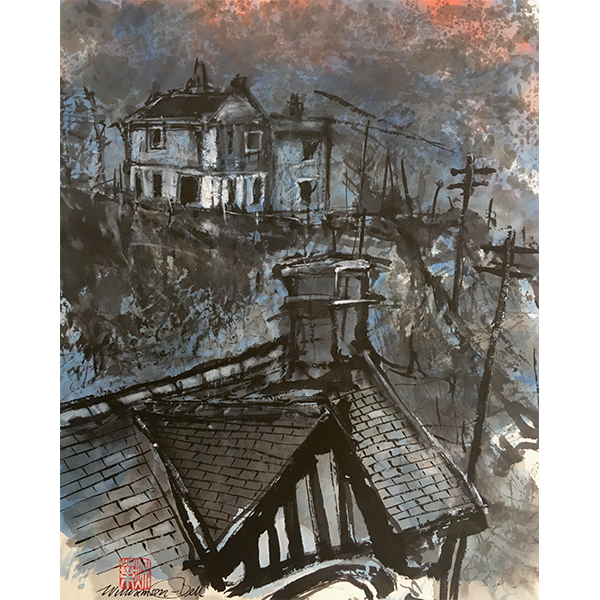
James Williamson Bell
Ouseburn, Newcastle upon Tyne
Ink and watercolour on paper
31.5 x 26cm (image)
49 x 43cm (framed)
This work is signed by the artist.
Bell’s subject matter was as diverse as his style. As one of the first members of the prestigious Society of Wildlife Artists (and for a long period, the only member in the North of England), he produced finely detailed studies of native and exotic birds. As his reputation grew, Bell was able to travel more widely, spending many months in China where he developed a fascination with Chinese brush painting. The technique strongly influenced his painting, as suited to capturing the inky river darkness and soaring cranes of the shipyards as it was to the lantern-lined Shanxi streets and shrieking cockerels of the Far East.
Bell exhibited his work as far afield as Paris, New York, South Korea, Nairobi and China, but it was the River Tyne and industrial North East which provided the rich source of imagery that he returned to again and again. Towering cranes at Wallsend, characterful North Shields pubs and crowded Newcastle bridges all feature in his work, alongside exquisitely detailed wildlife studies and energetic travel sketches. Taken together, these images create not just a portrait of working life on Tyneside, but of an artist overflowing with creativity and a drive to capture the world around him.

James Williamson Bell
North Shields, The Low Lights
Silkscreen, limited edition of 30
Mounted in conservation mountboard
Each print is signed and numbered by the artist.
James Williamson Bell lived and worked in Newcastle upon Tyne, producing works in a wide range of medias and styles. Bell was strongly influenced by Chinese art, which fascinated him. He spent many months living and working in parts of China, often signing his work with a red 'chop', a woodcut stamp typical of Chinese and Eastern art.
Ask us about framing this artwork
0191 261 4465

James Williamson Bell
All Saints Church, Newcastle upon Tyne
Hand coloured silkscreen, AP
17 x 12.5cm (image)
39 x 33cm (framed)
This work is signed by the artist.
Bell’s subject matter was as diverse as his style. As one of the first members of the prestigious Society of Wildlife Artists (and for a long period, the only member in the North of England), he produced finely detailed studies of native and exotic birds. As his reputation grew, Bell was able to travel more widely, spending many months in China where he developed a fascination with Chinese brush painting. The technique strongly influenced his painting, as suited to capturing the inky river darkness and soaring cranes of the shipyards as it was to the lantern-lined Shanxi streets and shrieking cockerels of the Far East.
Bell exhibited his work as far afield as Paris, New York, South Korea, Nairobi and China, but it was the River Tyne and industrial North East which provided the rich source of imagery that he returned to again and again. Towering cranes at Wallsend, characterful North Shields pubs and crowded Newcastle bridges all feature in his work, alongside exquisitely detailed wildlife studies and energetic travel sketches. Taken together, these images create not just a portrait of working life on Tyneside, but of an artist overflowing with creativity and a drive to capture the world around him.

James Williamson Bell
Apricale, Italy
Monotype
37.5 x 48.5cm (image)
60 x 70cm (framed)
This work is signed by the artist.
Bell’s subject matter was as diverse as his style. As one of the first members of the prestigious Society of Wildlife Artists (and for a long period, the only member in the North of England), he produced finely detailed studies of native and exotic birds. As his reputation grew, Bell was able to travel more widely, spending many months in China where he developed a fascination with Chinese brush painting. The technique strongly influenced his painting, as suited to capturing the inky river darkness and soaring cranes of the shipyards as it was to the lantern-lined Shanxi streets and shrieking cockerels of the Far East.
Bell exhibited his work as far afield as Paris, New York, South Korea, Nairobi and China, but it was the River Tyne and industrial North East which provided the rich source of imagery that he returned to again and again. Towering cranes at Wallsend, characterful North Shields pubs and crowded Newcastle bridges all feature in his work, alongside exquisitely detailed wildlife studies and energetic travel sketches. Taken together, these images create not just a portrait of working life on Tyneside, but of an artist overflowing with creativity and a drive to capture the world around him.

James Williamson Bell
Apricale Hillside, Italy
Monotype
49 x 37cm (image)
70 x 59cm (framed)
This work is signed by the artist.
Bell’s subject matter was as diverse as his style. As one of the first members of the prestigious Society of Wildlife Artists (and for a long period, the only member in the North of England), he produced finely detailed studies of native and exotic birds. As his reputation grew, Bell was able to travel more widely, spending many months in China where he developed a fascination with Chinese brush painting. The technique strongly influenced his painting, as suited to capturing the inky river darkness and soaring cranes of the shipyards as it was to the lantern-lined Shanxi streets and shrieking cockerels of the Far East.
Bell exhibited his work as far afield as Paris, New York, South Korea, Nairobi and China, but it was the River Tyne and industrial North East which provided the rich source of imagery that he returned to again and again. Towering cranes at Wallsend, characterful North Shields pubs and crowded Newcastle bridges all feature in his work, alongside exquisitely detailed wildlife studies and energetic travel sketches. Taken together, these images create not just a portrait of working life on Tyneside, but of an artist overflowing with creativity and a drive to capture the world around him.

James Williamson Bell
Hoult's Yard, Newcastle upon Tyne
Charcoal and pencil on paper
55.5 x 38cm (image)
76 x 58cm (framed)
This work is signed by the artist.
Bell’s subject matter was as diverse as his style. As one of the first members of the prestigious Society of Wildlife Artists (and for a long period, the only member in the North of England), he produced finely detailed studies of native and exotic birds. As his reputation grew, Bell was able to travel more widely, spending many months in China where he developed a fascination with Chinese brush painting. The technique strongly influenced his painting, as suited to capturing the inky river darkness and soaring cranes of the shipyards as it was to the lantern-lined Shanxi streets and shrieking cockerels of the Far East.
Bell exhibited his work as far afield as Paris, New York, South Korea, Nairobi and China, but it was the River Tyne and industrial North East which provided the rich source of imagery that he returned to again and again. Towering cranes at Wallsend, characterful North Shields pubs and crowded Newcastle bridges all feature in his work, alongside exquisitely detailed wildlife studies and energetic travel sketches. Taken together, these images create not just a portrait of working life on Tyneside, but of an artist overflowing with creativity and a drive to capture the world around him.

James Williamson Bell
Swan Hunter, Wallsend
Chinese Ink and watercolour on paper
32 x 56cm (image)
52 x 78cm (framed)
This work is signed by the artist.
Bell’s subject matter was as diverse as his style. As one of the first members of the prestigious Society of Wildlife Artists (and for a long period, the only member in the North of England), he produced finely detailed studies of native and exotic birds. As his reputation grew, Bell was able to travel more widely, spending many months in China where he developed a fascination with Chinese brush painting. The technique strongly influenced his painting, as suited to capturing the inky river darkness and soaring cranes of the shipyards as it was to the lantern-lined Shanxi streets and shrieking cockerels of the Far East.
Bell exhibited his work as far afield as Paris, New York, South Korea, Nairobi and China, but it was the River Tyne and industrial North East which provided the rich source of imagery that he returned to again and again. Towering cranes at Wallsend, characterful North Shields pubs and crowded Newcastle bridges all feature in his work, alongside exquisitely detailed wildlife studies and energetic travel sketches. Taken together, these images create not just a portrait of working life on Tyneside, but of an artist overflowing with creativity and a drive to capture the world around him.

James Williamson Bell
Fish Quay Rooftops, North Shields
Charcoal drawing and screen print on paper
22.5 x 23.5cm (image)
42 x 42cm (framed)
This work is signed by the artist.
Bell’s subject matter was as diverse as his style. As one of the first members of the prestigious Society of Wildlife Artists (and for a long period, the only member in the North of England), he produced finely detailed studies of native and exotic birds. As his reputation grew, Bell was able to travel more widely, spending many months in China where he developed a fascination with Chinese brush painting. The technique strongly influenced his painting, as suited to capturing the inky river darkness and soaring cranes of the shipyards as it was to the lantern-lined Shanxi streets and shrieking cockerels of the Far East.
Bell exhibited his work as far afield as Paris, New York, South Korea, Nairobi and China, but it was the River Tyne and industrial North East which provided the rich source of imagery that he returned to again and again. Towering cranes at Wallsend, characterful North Shields pubs and crowded Newcastle bridges all feature in his work, alongside exquisitely detailed wildlife studies and energetic travel sketches. Taken together, these images create not just a portrait of working life on Tyneside, but of an artist overflowing with creativity and a drive to capture the world around him.

James Williamson Bell
Castle and Blackgate, Newcastle upon Tyne
Silkscreen ed. 7/75
48 x 33cm (image)
70 x 53cm (framed)
Bell’s subject matter was as diverse as his style. As one of the first members of the prestigious Society of Wildlife Artists (and for a long period, the only member in the North of England), he produced finely detailed studies of native and exotic birds. As his reputation grew, Bell was able to travel more widely, spending many months in China where he developed a fascination with Chinese brush painting. The technique strongly influenced his painting, as suited to capturing the inky river darkness and soaring cranes of the shipyards as it was to the lantern-lined Shanxi streets and shrieking cockerels of the Far East.
Bell exhibited his work as far afield as Paris, New York, South Korea, Nairobi and China, but it was the River Tyne and industrial North East which provided the rich source of imagery that he returned to again and again. Towering cranes at Wallsend, characterful North Shields pubs and crowded Newcastle bridges all feature in his work, alongside exquisitely detailed wildlife studies and energetic travel sketches. Taken together, these images create not just a portrait of working life on Tyneside, but of an artist overflowing with creativity and a drive to capture the world around him.

James Williamson Bell
Rose and Crown, Newcastle
Pencil and watercolour on paper
Signed by the artist
30.5 x 20.5cm (image)
Mounted in conservation mount board
James Williamson Bell’s subject matter was as diverse as his style. As one of the first members of the prestigious Society of Wildlife Artists (and for a long period, the only member in the North of England), he produced finely detailed studies of native and exotic birds. As his reputation grew, Bell was able to travel more widely, spending many months in China where he developed a fascination with Chinese brush painting. The technique strongly influenced his painting, as suited to capturing the inky river darkness and soaring cranes of the shipyards as it was to the lantern-lined Shanxi streets and shrieking cockerels of the Far East.
Bell exhibited his work as far afield as Paris, New York, South Korea, Nairobi and China, but it was the River Tyne and industrial North East which provided the rich source of imagery that he returned to again and again. Towering cranes at Wallsend, characterful North Shields pubs and crowded Newcastle bridges all feature in his work, alongside exquisitely detailed wildlife studies and energetic travel sketches. Taken together, these images create not just a portrait of working life on Tyneside, but of an artist overflowing with creativity and a drive to capture the world around him.

James Williamson Bell
Big Market, Newcastle
Silkscreen, edition 15/45
Signed and numbered by the artist
29 x 22.5cm (image)
Mounted in conservation mount board
James Williamson Bell’s subject matter was as diverse as his style. As one of the first members of the prestigious Society of Wildlife Artists (and for a long period, the only member in the North of England), he produced finely detailed studies of native and exotic birds. As his reputation grew, Bell was able to travel more widely, spending many months in China where he developed a fascination with Chinese brush painting. The technique strongly influenced his painting, as suited to capturing the inky river darkness and soaring cranes of the shipyards as it was to the lantern-lined Shanxi streets and shrieking cockerels of the Far East.
Bell exhibited his work as far afield as Paris, New York, South Korea, Nairobi and China, but it was the River Tyne and industrial North East which provided the rich source of imagery that he returned to again and again. Towering cranes at Wallsend, characterful North Shields pubs and crowded Newcastle bridges all feature in his work, alongside exquisitely detailed wildlife studies and energetic travel sketches. Taken together, these images create not just a portrait of working life on Tyneside, but of an artist overflowing with creativity and a drive to capture the world around him.

James Williamson Bell
Landscape Study
Silkscreen, edition 2/20
Signed and numbered by the artist
28 x 21cm (image)
Mounted in conservation mount board
James Williamson Bell’s subject matter was as diverse as his style. As one of the first members of the prestigious Society of Wildlife Artists (and for a long period, the only member in the North of England), he produced finely detailed studies of native and exotic birds. As his reputation grew, Bell was able to travel more widely, spending many months in China where he developed a fascination with Chinese brush painting. The technique strongly influenced his painting, as suited to capturing the inky river darkness and soaring cranes of the shipyards as it was to the lantern-lined Shanxi streets and shrieking cockerels of the Far East.
Bell exhibited his work as far afield as Paris, New York, South Korea, Nairobi and China, but it was the River Tyne and industrial North East which provided the rich source of imagery that he returned to again and again. Towering cranes at Wallsend, characterful North Shields pubs and crowded Newcastle bridges all feature in his work, alongside exquisitely detailed wildlife studies and energetic travel sketches. Taken together, these images create not just a portrait of working life on Tyneside, but of an artist overflowing with creativity and a drive to capture the world around him.

James Williamson Bell
Passage Falcon
Lithograph, Artists Proof
Signed and numbered by the artist
30 x 44cm (image)
Mounted in conservation mount board
The paper has some foxing and will need some conversation work
James Williamson Bell’s subject matter was as diverse as his style. As one of the first members of the prestigious Society of Wildlife Artists (and for a long period, the only member in the North of England), he produced finely detailed studies of native and exotic birds. As his reputation grew, Bell was able to travel more widely, spending many months in China where he developed a fascination with Chinese brush painting. The technique strongly influenced his painting, as suited to capturing the inky river darkness and soaring cranes of the shipyards as it was to the lantern-lined Shanxi streets and shrieking cockerels of the Far East.
Bell exhibited his work as far afield as Paris, New York, South Korea, Nairobi and China, but it was the River Tyne and industrial North East which provided the rich source of imagery that he returned to again and again. Towering cranes at Wallsend, characterful North Shields pubs and crowded Newcastle bridges all feature in his work, alongside exquisitely detailed wildlife studies and energetic travel sketches. Taken together, these images create not just a portrait of working life on Tyneside, but of an artist overflowing with creativity and a drive to capture the world around him.

James Williamson Bell
Panda in Tree
Silkscreen, edition 2/50
Signed and numbered by the artist
28.5 x 21cm (image)
Mounted in conservation mount board
James Williamson Bell’s subject matter was as diverse as his style. As one of the first members of the prestigious Society of Wildlife Artists (and for a long period, the only member in the North of England), he produced finely detailed studies of native and exotic birds. As his reputation grew, Bell was able to travel more widely, spending many months in China where he developed a fascination with Chinese brush painting. The technique strongly influenced his painting, as suited to capturing the inky river darkness and soaring cranes of the shipyards as it was to the lantern-lined Shanxi streets and shrieking cockerels of the Far East.
Bell exhibited his work as far afield as Paris, New York, South Korea, Nairobi and China, but it was the River Tyne and industrial North East which provided the rich source of imagery that he returned to again and again. Towering cranes at Wallsend, characterful North Shields pubs and crowded Newcastle bridges all feature in his work, alongside exquisitely detailed wildlife studies and energetic travel sketches. Taken together, these images create not just a portrait of working life on Tyneside, but of an artist overflowing with creativity and a drive to capture the world around him.

James Williamson Bell
Church and Graveyard
Silkscreen print, edition 1/15, Apollo Fine Art stamp
Signed and numbered by the artist
45.5 x 35.5cm (image)
Mounted in conservation mount board
James Williamson Bell’s subject matter was as diverse as his style. As one of the first members of the prestigious Society of Wildlife Artists (and for a long period, the only member in the North of England), he produced finely detailed studies of native and exotic birds. As his reputation grew, Bell was able to travel more widely, spending many months in China where he developed a fascination with Chinese brush painting. The technique strongly influenced his painting, as suited to capturing the inky river darkness and soaring cranes of the shipyards as it was to the lantern-lined Shanxi streets and shrieking cockerels of the Far East.
Bell exhibited his work as far afield as Paris, New York, South Korea, Nairobi and China, but it was the River Tyne and industrial North East which provided the rich source of imagery that he returned to again and again. Towering cranes at Wallsend, characterful North Shields pubs and crowded Newcastle bridges all feature in his work, alongside exquisitely detailed wildlife studies and energetic travel sketches. Taken together, these images create not just a portrait of working life on Tyneside, but of an artist overflowing with creativity and a drive to capture the world around him.

James Williamson Bell
Apricale
Silkscreen print, edition 3/15
Signed and numbered by the artist
40 x 56cm (image)
Mounted in conservation mount board
James Williamson Bell’s subject matter was as diverse as his style. As one of the first members of the prestigious Society of Wildlife Artists (and for a long period, the only member in the North of England), he produced finely detailed studies of native and exotic birds. As his reputation grew, Bell was able to travel more widely, spending many months in China where he developed a fascination with Chinese brush painting. The technique strongly influenced his painting, as suited to capturing the inky river darkness and soaring cranes of the shipyards as it was to the lantern-lined Shanxi streets and shrieking cockerels of the Far East.
Bell exhibited his work as far afield as Paris, New York, South Korea, Nairobi and China, but it was the River Tyne and industrial North East which provided the rich source of imagery that he returned to again and again. Towering cranes at Wallsend, characterful North Shields pubs and crowded Newcastle bridges all feature in his work, alongside exquisitely detailed wildlife studies and energetic travel sketches. Taken together, these images create not just a portrait of working life on Tyneside, but of an artist overflowing with creativity and a drive to capture the world around him.

James Williamson Bell
Venice II
Silkscreen print, edition 2/30
Signed and numbered by the artist
24 x 23cm (image)
Mounted in conservation mount board
James Williamson Bell’s subject matter was as diverse as his style. As one of the first members of the prestigious Society of Wildlife Artists (and for a long period, the only member in the North of England), he produced finely detailed studies of native and exotic birds. As his reputation grew, Bell was able to travel more widely, spending many months in China where he developed a fascination with Chinese brush painting. The technique strongly influenced his painting, as suited to capturing the inky river darkness and soaring cranes of the shipyards as it was to the lantern-lined Shanxi streets and shrieking cockerels of the Far East.
Bell exhibited his work as far afield as Paris, New York, South Korea, Nairobi and China, but it was the River Tyne and industrial North East which provided the rich source of imagery that he returned to again and again. Towering cranes at Wallsend, characterful North Shields pubs and crowded Newcastle bridges all feature in his work, alongside exquisitely detailed wildlife studies and energetic travel sketches. Taken together, these images create not just a portrait of working life on Tyneside, but of an artist overflowing with creativity and a drive to capture the world around him.

James Williamson Bell
Venice I
Limited edition silkscreen print
Signed by the artist
23 x 24cm (image)
Mounted in conservation mount board
James Williamson Bell’s subject matter was as diverse as his style. As one of the first members of the prestigious Society of Wildlife Artists (and for a long period, the only member in the North of England), he produced finely detailed studies of native and exotic birds. As his reputation grew, Bell was able to travel more widely, spending many months in China where he developed a fascination with Chinese brush painting. The technique strongly influenced his painting, as suited to capturing the inky river darkness and soaring cranes of the shipyards as it was to the lantern-lined Shanxi streets and shrieking cockerels of the Far East.
Bell exhibited his work as far afield as Paris, New York, South Korea, Nairobi and China, but it was the River Tyne and industrial North East which provided the rich source of imagery that he returned to again and again. Towering cranes at Wallsend, characterful North Shields pubs and crowded Newcastle bridges all feature in his work, alongside exquisitely detailed wildlife studies and energetic travel sketches. Taken together, these images create not just a portrait of working life on Tyneside, but of an artist overflowing with creativity and a drive to capture the world around him.

James Williamson Bell
Leningrad
Charcoal drawing and screen print on paper
Signed and stamped by the artist
18.5 x 18cm (image)
Mounted in conservation mount board
James Williamson Bell’s subject matter was as diverse as his style. As one of the first members of the prestigious Society of Wildlife Artists (and for a long period, the only member in the North of England), he produced finely detailed studies of native and exotic birds. As his reputation grew, Bell was able to travel more widely, spending many months in China where he developed a fascination with Chinese brush painting. The technique strongly influenced his painting, as suited to capturing the inky river darkness and soaring cranes of the shipyards as it was to the lantern-lined Shanxi streets and shrieking cockerels of the Far East.
Bell exhibited his work as far afield as Paris, New York, South Korea, Nairobi and China, but it was the River Tyne and industrial North East which provided the rich source of imagery that he returned to again and again. Towering cranes at Wallsend, characterful North Shields pubs and crowded Newcastle bridges all feature in his work, alongside exquisitely detailed wildlife studies and energetic travel sketches. Taken together, these images create not just a portrait of working life on Tyneside, but of an artist overflowing with creativity and a drive to capture the world around him.

James Williamson Bell
High Lights - North Shields
Charcoal drawing and screen print on paper
Signed and stamped by the artist
24 x 24cm (image)
Mounted in conservation mount board
James Williamson Bell’s subject matter was as diverse as his style. As one of the first members of the prestigious Society of Wildlife Artists (and for a long period, the only member in the North of England), he produced finely detailed studies of native and exotic birds. As his reputation grew, Bell was able to travel more widely, spending many months in China where he developed a fascination with Chinese brush painting. The technique strongly influenced his painting, as suited to capturing the inky river darkness and soaring cranes of the shipyards as it was to the lantern-lined Shanxi streets and shrieking cockerels of the Far East.
Bell exhibited his work as far afield as Paris, New York, South Korea, Nairobi and China, but it was the River Tyne and industrial North East which provided the rich source of imagery that he returned to again and again. Towering cranes at Wallsend, characterful North Shields pubs and crowded Newcastle bridges all feature in his work, alongside exquisitely detailed wildlife studies and energetic travel sketches. Taken together, these images create not just a portrait of working life on Tyneside, but of an artist overflowing with creativity and a drive to capture the world around him.

James Williamson Bell
Grouse
Silkscreen print, edition 4/18
Signed and numbered by the artist
27.5 x 20cm (image)
Mounted in conservation mount board
James Williamson Bell’s subject matter was as diverse as his style. As one of the first members of the prestigious Society of Wildlife Artists (and for a long period, the only member in the North of England), he produced finely detailed studies of native and exotic birds. As his reputation grew, Bell was able to travel more widely, spending many months in China where he developed a fascination with Chinese brush painting. The technique strongly influenced his painting, as suited to capturing the inky river darkness and soaring cranes of the shipyards as it was to the lantern-lined Shanxi streets and shrieking cockerels of the Far East.
Bell exhibited his work as far afield as Paris, New York, South Korea, Nairobi and China, but it was the River Tyne and industrial North East which provided the rich source of imagery that he returned to again and again. Towering cranes at Wallsend, characterful North Shields pubs and crowded Newcastle bridges all feature in his work, alongside exquisitely detailed wildlife studies and energetic travel sketches. Taken together, these images create not just a portrait of working life on Tyneside, but of an artist overflowing with creativity and a drive to capture the world around him.

James Williamson Bell
Wallsend Shipyard
Charcoal drawing and screen print on paper
Signed and stamped by the artist
24 x 24cm (image)
Mounted in conservation mount board
James Williamson Bell’s subject matter was as diverse as his style. As one of the first members of the prestigious Society of Wildlife Artists (and for a long period, the only member in the North of England), he produced finely detailed studies of native and exotic birds. As his reputation grew, Bell was able to travel more widely, spending many months in China where he developed a fascination with Chinese brush painting. The technique strongly influenced his painting, as suited to capturing the inky river darkness and soaring cranes of the shipyards as it was to the lantern-lined Shanxi streets and shrieking cockerels of the Far East.
Bell exhibited his work as far afield as Paris, New York, South Korea, Nairobi and China, but it was the River Tyne and industrial North East which provided the rich source of imagery that he returned to again and again. Towering cranes at Wallsend, characterful North Shields pubs and crowded Newcastle bridges all feature in his work, alongside exquisitely detailed wildlife studies and energetic travel sketches. Taken together, these images create not just a portrait of working life on Tyneside, but of an artist overflowing with creativity and a drive to capture the world around him.

James Williamson Bell
South Shields Drydock
Silkscreen print, edition 3/50
Signed and numbered by the artist
28 x 19cm (image)
Mounted in conservation mount board
James Williamson Bell’s subject matter was as diverse as his style. As one of the first members of the prestigious Society of Wildlife Artists (and for a long period, the only member in the North of England), he produced finely detailed studies of native and exotic birds. As his reputation grew, Bell was able to travel more widely, spending many months in China where he developed a fascination with Chinese brush painting. The technique strongly influenced his painting, as suited to capturing the inky river darkness and soaring cranes of the shipyards as it was to the lantern-lined Shanxi streets and shrieking cockerels of the Far East.
Bell exhibited his work as far afield as Paris, New York, South Korea, Nairobi and China, but it was the River Tyne and industrial North East which provided the rich source of imagery that he returned to again and again. Towering cranes at Wallsend, characterful North Shields pubs and crowded Newcastle bridges all feature in his work, alongside exquisitely detailed wildlife studies and energetic travel sketches. Taken together, these images create not just a portrait of working life on Tyneside, but of an artist overflowing with creativity and a drive to capture the world around him.
James Williamson Bell
Sparrow
Woodcut, ed. 6/75
10.5 x 9.5cm (image)
29 x 30cm (framed)
This work is signed by the artist.
Bell’s subject matter was as diverse as his style. As one of the first members of the prestigious Society of Wildlife Artists (and for a long period, the only member in the North of England), he produced finely detailed studies of native and exotic birds. As his reputation grew, Bell was able to travel more widely, spending many months in China where he developed a fascination with Chinese brush painting. The technique strongly influenced his painting, as suited to capturing the inky river darkness and soaring cranes of the shipyards as it was to the lantern-lined Shanxi streets and shrieking cockerels of the Far East.
Bell exhibited his work as far afield as Paris, New York, South Korea, Nairobi and China, but it was the River Tyne and industrial North East which provided the rich source of imagery that he returned to again and again. Towering cranes at Wallsend, characterful North Shields pubs and crowded Newcastle bridges all feature in his work, alongside exquisitely detailed wildlife studies and energetic travel sketches. Taken together, these images create not just a portrait of working life on Tyneside, but of an artist overflowing with creativity and a drive to capture the world around him.
Information for buyers